Search: #math #video
2 posts
2 posts
The Unique Synthesis of Art and Mathematics
Maurits Cornelis (M.C.) Escher (1898-1972) is celebrated for his unique ability to represent the perfect fusion of mathematics and art, bringing these two seemingly disparate worlds together into a singular, cohesive vision. Born in the Netherlands, Escher began his professional life as a graphic artist specializing in woodcuts and lithographs, with no formal training in mathematics. His artistic direction was irrevocably shaped by a visit to the Alhambra palace in Spain, where he became captivated by the geometric decorations of the Moorish tiles. This experience became a defining moment, sparking a lifelong exploration of the mathematical concept of tessellation.
Tessellation: From Abstract Geometry to Fantastical Worlds
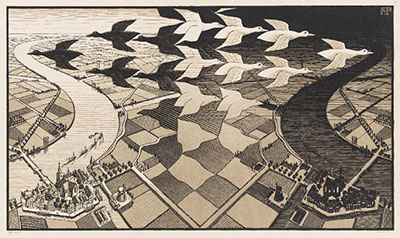
At the core of much of Escher’s work is tessellation, the mathematical principle of dividing a plane with regular, repeating patterns or "tiles" that fit together perfectly without overlapping or leaving gaps. While the concept is mathematically fundamental and deeply connected to the principles of symmetry, Escher’s genius lay in his ability to elevate this abstract idea. Instead of using simple geometric shapes, he infused his tessellations with a human and fantastical dimension. He populated his planes with intricate, interlocking figures of animals, lizards, draconic creatures, and goblins, transforming a Stark mathematical concept into a vibrant, imaginative world.

The Evolution of Escher’s Work: Two Distinct Periods
Escher's artistic career can be broadly categorized into two distinct periods. His early work was largely intuitive, driven by his personal fascination with repeating patterns and tessellations without direct collaboration with mathematicians. However, his work entered a new phase of profound depth and sophistication after he began to engage with the mathematical community. In this later period, his art delved into much more complex and abstract concepts. He explored themes of dimension, the topology (or shape) of space, and the nature of infinity. His artistic inquiries were so forward-thinking that some of his work has been seen as anticipating advanced scientific ideas; modern cosmologists have even theorized that the shape of our universe might be "Escher-shaped," suggesting his art touched upon deep features of modern cosmology.
Exploring Infinity, Paradox, and Perception
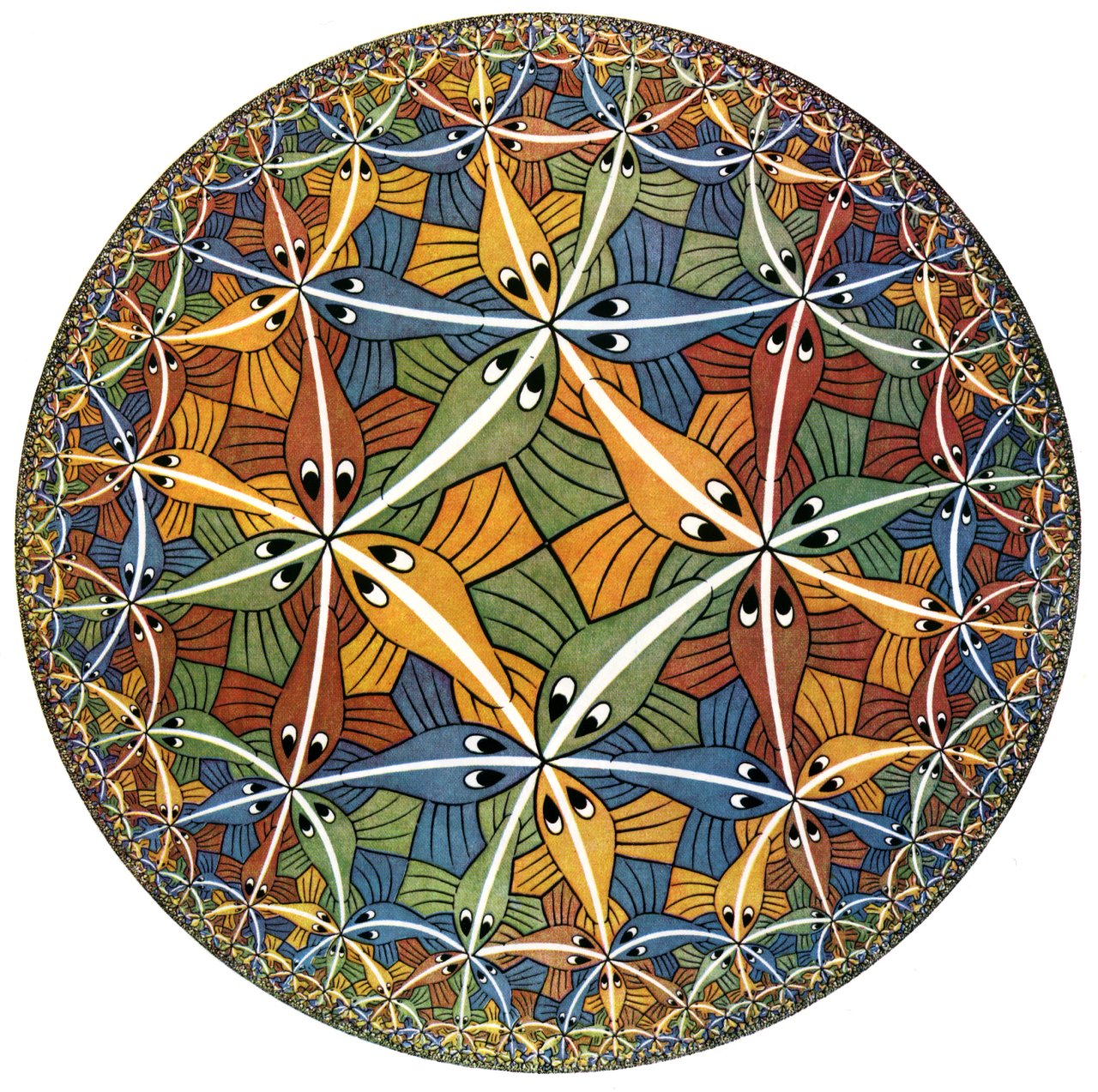
In his later period, Escher created some of his most famous and mathematically rigorous pieces. Using only basic drawing tools, he produced Circle Limit III, an astonishingly accurate representation of space as it edges towards infinity. The work’s precision was so remarkable that, nearly 40 years after its creation, mathematicians confirmed it was mathematically correct down to the millimeter.
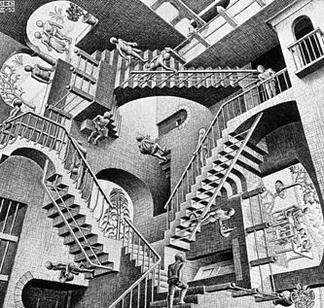
Escher was also deeply inspired by paradoxes and visual illusions. He was fascinated by the work of mathematicians like Roger Penrose, who created the "impossible triangle" and by the peculiar properties of the Möbius strip, an object that appears to have only one side. He used these ideas to create iconic images that look convincing at first glance but defy logic upon closer inspection. These visual illusions serve as a powerful commentary on the nature of perception, demonstrating that our brains do not passively see the world but actively interpret sensory input and make assumptions. Escher's work gives this interpretive part of the brain a "real workout," challenging our understanding of what is real and what is possible.
An Enduring Legacy in Mathematics and Art
Until his death in 1972, Escher remained intrigued by the concepts of infinity, reflection, and perception. His legacy endures, particularly within the world of mathematics. His prints are ubiquitous in university mathematics departments, adorning walls and appearing in textbooks. This is because his art speaks directly to mathematicians, offering a tangible, visual representation of the abstract beauty they find in their field. From a modern perspective, mathematicians understand more clearly what Escher was trying to achieve and can now even write down the formulas that describe the mathematical ideas behind his intuitive creations. Ultimately, M.C. Escher’s greatest contribution was his ability to bridge the gap between two cultures, using his artistic skill to show the wider world that the subject of mathematics is, in its essence, beautiful.