Search: #science #video
4 posts
4 posts
"Everybody's Free (To Wear Sunscreen)" is a globally recognized spoken-word track by Baz Luhrmann, released in 1999. The lyrics are directly adapted from a hypothetical commencement address written by columnist Mary Schmich, originally published in the Chicago Tribune in 1997. The piece delivers a series of practical, philosophical, and tongue-in-cheek life lessons directed at the "Class of '99," though its themes remain universally applicable across generations.
The speech is structured around a central premise: physical protection (wearing sunscreen) is the only advice with definitive, scientifically proven long-term benefits. The rest of the speaker's advice is admittedly subjective, drawn from a "meandering" personal history rather than empirical facts.
Key themes and guidance offered in the address include:
Appreciating Youth and Body Image: The speaker urges young people to enjoy their youth and body without self-consciousness. He notes that people rarely appreciate their own beauty and the infinite possibilities ahead of them until those assets have faded. He highlights the futility of worrying about physical flaws (such as weight), as well as the pointlessness of worrying about the future in general.
Managing Anxiety and the Unpredictable: Worrying is compared to trying to "solve an algebra equation by chewing bubble gum." True hardships are rarely the ones we worry about; rather, they are the unexpected, random events that "blindside you at 4 p.m. on some idle Tuesday."
Interpersonal Relationships and Emotions: He advises listeners to do something scary every day, to sing, and to avoid both being reckless with others' hearts and tolerating those who are reckless with theirs. He cautions against jealousy, reminding the audience that life's race is long and ultimately only with oneself. Furthermore, he encourages holding onto compliments, discarding insults, and keeping old love letters while tossing out dry financial records like bank statements.
Career and Self-Expectation: The speaker reassures the audience that it is completely normal not to know what to do with one's life. He points out that some of the most interesting 22-year-olds—and even 40-year-olds—still do not have their careers or lives figured out.
Physical Health and Well-being: Practical physical advice includes stretching, getting enough calcium, flossing, and protecting one's knees, which are deeply missed once they fail. He also emphasizes dancing as a vital outlet, even if it is only done alone in a living room.
Lifestyle, Travel, and Environment: The speech contrasts different environments, recommending living in New York City (but leaving before it hardens you) and living in Northern California (but leaving before it softens you). It also recommends traveling as a way to broaden perspectives.
Family and Sibling Bonds: Listeners are urged to cherish their parents, as they will not be around forever, and to be nice to their siblings. Siblings are described as the best link to one's past and the people most likely to offer support in the future.
Acceptance of Aging and Change: The speaker highlights "inalienable truths": prices will rise, politicians will philander, and everyone will get old. With age comes a nostalgic fantasy that the past was better, cheaper, and more respectful.
Self-Reliance and Wealth: The audience is cautioned not to rely on others for financial support, whether through a trust fund or a wealthy spouse, as these can dry up at any moment.
The Nature of Advice: Finally, the speaker reflects on the concept of advice itself, defining it as a form of "nostalgia." Giving advice is described as a way of "fishing the past from the disposal," cleaning it up, painting over the flaws, and recycling it for more than it is worth. Despite this skepticism toward unsolicited wisdom, he reiterates his primary, concrete recommendation: "trust me on the sunscreen."
Ladies and gentlemen of the class of '99: Wear sunscreen.
If I could offer you only one tip for the future, sunscreen would be it. The long-term benefits of sunscreen have been proved by scientists, whereas the rest of my advice has no basis more reliable than my own meandering experience. I will dispense this advice now.
Enjoy the power and beauty of your youth. Oh, never mind; you will not understand the power and beauty of your youth until they've faded. But trust me, in 20 years you’ll look back at photos of yourself and recall in a way you can't grasp now how much possibility lay before you and how fabulous you really looked. You are not as fat as you imagine.
Don't worry about the future. Or worry, but know that worrying is as effective as trying to solve an algebra equation by chewing bubble gum. The real troubles in your life are apt to be things that never crossed your worried mind—the kind that blindsides you at 4 p.m. on some idle Tuesday.
Do one thing every day that scares you.
Sing.
Don't be reckless with other people's hearts. Don't put up with people who are reckless with yours.
Floss.
Don't waste your time on jealousy. Sometimes you're ahead, sometimes you're behind. The race is long, and in the end, it's only with yourself.
Remember compliments you receive; forget the insults. If you succeed in doing this, tell me how.
Keep your old love letters. Throw away your old bank statements.
Stretch.
Don't feel guilty if you don't know what you want to do with your life. The most interesting people I know didn't know at 22 what they wanted to do with their lives. Some of the most interesting 40-year-olds I know still don't.
Get plenty of calcium. Be kind to your knees; you'll miss them when they're gone.
Maybe you'll marry, maybe you won't. Maybe you'll have children, maybe you won't. Maybe you'll divorce at 40, maybe you'll dance the funky chicken on your 75th wedding anniversary. Whatever you do, don't congratulate yourself too much, or berate yourself either. Your choices are half chance; so are everybody else's.
Enjoy your body. Use it every way you can. Don't be afraid of it or what other people think of it; it's the greatest instrument you'll ever own.
Dance, even if you have nowhere to do it but in your own living room.
Read the directions, even if you don't follow them.
Do not read beauty magazines; they will only make you feel ugly.
Get to know your parents; you never know when they'll be gone for good.
Be nice to your siblings; they are your best link to your past and the people most likely to stick with you in the future.
Understand that friends come and go, but with a precious few, you should hold on. Work hard to bridge the gaps in geography and lifestyle, because the older you get, the more you need the people you knew when you were young.
Live in New York City once, but leave before it makes you hard. Live in Northern California once, but leave before it makes you soft.
Travel.
Accept certain inalienable truths: prices will rise, politicians will philander, you too will get old. And when you do, you'll fantasize that when you were young, prices were reasonable, politicians were noble, and children respected their elders.
Respect your elders.
Don't expect anyone else to support you. Maybe you have a trust fund, maybe you'll have a wealthy spouse, but you never know when either one might run out.
Don't mess too much with your hair, or by the time you're 40, it will look 85.
Be careful whose advice you buy, but be patient with those who supply it. Advice is a form of nostalgia. Dispensing it is a way of fishing the past from the disposal, wiping it off, painting over the ugly parts, and recycling it for more than it's worth.
But trust me on the sunscreen.
A cognitive model of the human brain explains why thinking is often effortful and how our minds manage mental tasks, leading to both remarkable efficiencies and predictable errors.
The Effort of Thinking and Common Errors
The central premise is that thinking is an uncomfortable and demanding activity that humans instinctively try to avoid. This aversion is illustrated through common errors on seemingly simple questions. For instance, when asked the cost of a ball if a bat and ball together cost $1.10 and the bat costs $1.00 more than the ball, most people instinctively answer ten cents. This answer is incorrect (the correct answer is five cents), but it feels plausible. People fail to perform the simple mental check that would reveal the error because doing so requires conscious effort. These mistakes are not a result of low intelligence but rather demonstrate universal blind spots in human cognition, rooted in the fundamental way our brains are structured to conserve mental energy.
A Two-System Model: Gun and Drew
To explain this phenomenon, the brain's operation is modeled as an interaction between two distinct systems, personified as "Gun" (System One) and "Drew" (System Two).
Gun (System One): This system is incredibly fast, automatic, and operates unconsciously. Gun constantly processes vast amounts of sensory information, filtering for relevance, filling in contextual gaps (e.g., reading "THE CAT" even when the 'H' and 'A' are the same ambiguous symbol), and providing immediate, intuitive responses. His operations are the foundation for our perceptions and quick judgments.
Drew (System Two): Drew represents your conscious, deliberate thought—the voice in your head. He is slow, lazy, and requires significant effort to engage. However, Drew is also careful and analytical, capable of following complex instructions, performing step-by-step calculations (like 13 x 17), and catching the errors that Gun might make.
The Role of Memory and Learning
These two systems are intrinsically linked to our memory structures. Gun’s abilities are powered by long-term memory, the vast library of experiences and learned information accumulated over a lifetime. In contrast, Drew operates entirely within working memory, which has an extremely limited capacity, able to hold and manipulate only about four or five new pieces of information at once.
This limitation can be overcome through a process called chunking, where familiar information from long-term memory is grouped into a single conceptual unit. For example, the random digits "2-0-1-7" occupy four slots in working memory, but if recognized as the year 2017, they become a single, manageable chunk. Learning, therefore, is the process of building larger and more complex chunks in long-term memory. This is achieved through Drew's effortful, deliberate practice, which eventually automates a skill, effectively transferring the task from Drew to Gun. This is seen when learning to tie shoelaces or in the development of "muscle memory" by musicians and athletes.
Evidence and Errors of the Systems
The mental effort exerted by Drew is physically measurable. Cognitive tasks that demand Drew's full attention, such as the "Add-One" or "Add-Three" memory exercises, cause physiological responses like increased heart rate and pupil dilation. The fact that pupils remain normal during casual conversation indicates that for most of our daily lives, Drew is idle while Gun handles routine tasks automatically.
This division of labor is highly efficient but can lead to "mix-ups" when Gun's automated habits conflict with new situations, such as adapting to light switches that operate in the opposite direction or learning to ride a backwards bicycle. The "Bat and Ball" problem is a prime example of this system failure: Gun provides a quick, intuitive answer ("ten cents"), and the lazy Drew endorses it without engaging his critical, fact-checking abilities.
Engaging Drew for Better Thinking and Learning
To improve thinking and avoid such errors, Drew must be forced to engage. This can be achieved through "cognitive strain." One study found that when the "Bat and Ball" question was printed in a hard-to-read font, the error rate dropped from 85% to 35%. The difficult font prevented Gun from jumping to a quick conclusion, forcing him to pass the task to Drew, who then invested the necessary effort to find the correct answer.
This principle has significant real-world applications. In advertising, confusing or mysterious campaigns (like the "Un" insurance ads) are designed to bypass Gun's automatic ad-filtering and engage Drew's curiosity. In education, there is a shift away from passive lectures, which are easy to tune out, towards active learning methods like workshops and peer instruction. These methods force students to grapple with material, making Drew work harder, which is essential for deep learning, even if it feels more difficult and less pleasant. Ultimately, true learning and the development of expertise require a willingness to embrace this uncomfortable state of mental effort and fight through confusion.
The Unique Synthesis of Art and Mathematics
Maurits Cornelis (M.C.) Escher (1898-1972) is celebrated for his unique ability to represent the perfect fusion of mathematics and art, bringing these two seemingly disparate worlds together into a singular, cohesive vision. Born in the Netherlands, Escher began his professional life as a graphic artist specializing in woodcuts and lithographs, with no formal training in mathematics. His artistic direction was irrevocably shaped by a visit to the Alhambra palace in Spain, where he became captivated by the geometric decorations of the Moorish tiles. This experience became a defining moment, sparking a lifelong exploration of the mathematical concept of tessellation.
Tessellation: From Abstract Geometry to Fantastical Worlds
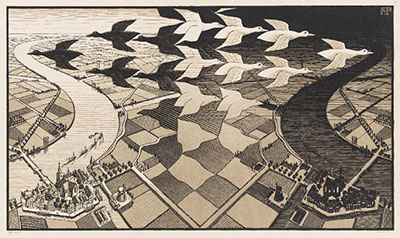
At the core of much of Escher’s work is tessellation, the mathematical principle of dividing a plane with regular, repeating patterns or "tiles" that fit together perfectly without overlapping or leaving gaps. While the concept is mathematically fundamental and deeply connected to the principles of symmetry, Escher’s genius lay in his ability to elevate this abstract idea. Instead of using simple geometric shapes, he infused his tessellations with a human and fantastical dimension. He populated his planes with intricate, interlocking figures of animals, lizards, draconic creatures, and goblins, transforming a Stark mathematical concept into a vibrant, imaginative world.

The Evolution of Escher’s Work: Two Distinct Periods
Escher's artistic career can be broadly categorized into two distinct periods. His early work was largely intuitive, driven by his personal fascination with repeating patterns and tessellations without direct collaboration with mathematicians. However, his work entered a new phase of profound depth and sophistication after he began to engage with the mathematical community. In this later period, his art delved into much more complex and abstract concepts. He explored themes of dimension, the topology (or shape) of space, and the nature of infinity. His artistic inquiries were so forward-thinking that some of his work has been seen as anticipating advanced scientific ideas; modern cosmologists have even theorized that the shape of our universe might be "Escher-shaped," suggesting his art touched upon deep features of modern cosmology.
Exploring Infinity, Paradox, and Perception
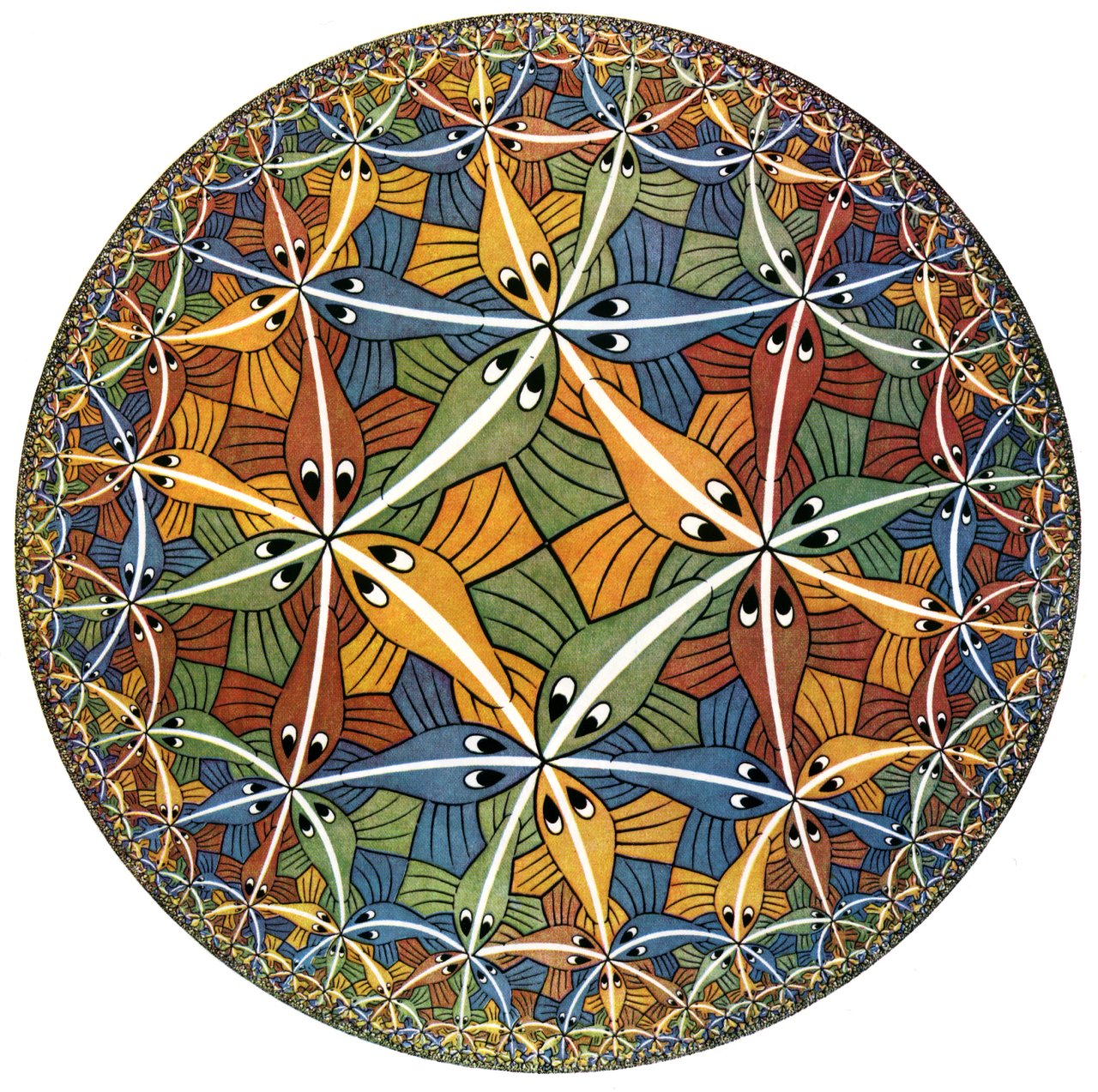
In his later period, Escher created some of his most famous and mathematically rigorous pieces. Using only basic drawing tools, he produced Circle Limit III, an astonishingly accurate representation of space as it edges towards infinity. The work’s precision was so remarkable that, nearly 40 years after its creation, mathematicians confirmed it was mathematically correct down to the millimeter.
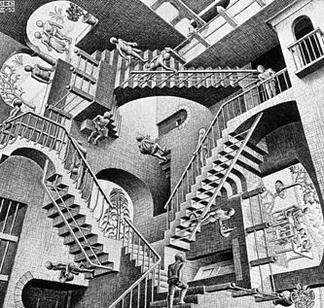
Escher was also deeply inspired by paradoxes and visual illusions. He was fascinated by the work of mathematicians like Roger Penrose, who created the "impossible triangle" and by the peculiar properties of the Möbius strip, an object that appears to have only one side. He used these ideas to create iconic images that look convincing at first glance but defy logic upon closer inspection. These visual illusions serve as a powerful commentary on the nature of perception, demonstrating that our brains do not passively see the world but actively interpret sensory input and make assumptions. Escher's work gives this interpretive part of the brain a "real workout," challenging our understanding of what is real and what is possible.
An Enduring Legacy in Mathematics and Art
Until his death in 1972, Escher remained intrigued by the concepts of infinity, reflection, and perception. His legacy endures, particularly within the world of mathematics. His prints are ubiquitous in university mathematics departments, adorning walls and appearing in textbooks. This is because his art speaks directly to mathematicians, offering a tangible, visual representation of the abstract beauty they find in their field. From a modern perspective, mathematicians understand more clearly what Escher was trying to achieve and can now even write down the formulas that describe the mathematical ideas behind his intuitive creations. Ultimately, M.C. Escher’s greatest contribution was his ability to bridge the gap between two cultures, using his artistic skill to show the wider world that the subject of mathematics is, in its essence, beautiful.