Search: #science -#quantum
19 posts
19 posts
"Everybody's Free (To Wear Sunscreen)" is a globally recognized spoken-word track by Baz Luhrmann, released in 1999. The lyrics are directly adapted from a hypothetical commencement address written by columnist Mary Schmich, originally published in the Chicago Tribune in 1997. The piece delivers a series of practical, philosophical, and tongue-in-cheek life lessons directed at the "Class of '99," though its themes remain universally applicable across generations.
The speech is structured around a central premise: physical protection (wearing sunscreen) is the only advice with definitive, scientifically proven long-term benefits. The rest of the speaker's advice is admittedly subjective, drawn from a "meandering" personal history rather than empirical facts.
Key themes and guidance offered in the address include:
Appreciating Youth and Body Image: The speaker urges young people to enjoy their youth and body without self-consciousness. He notes that people rarely appreciate their own beauty and the infinite possibilities ahead of them until those assets have faded. He highlights the futility of worrying about physical flaws (such as weight), as well as the pointlessness of worrying about the future in general.
Managing Anxiety and the Unpredictable: Worrying is compared to trying to "solve an algebra equation by chewing bubble gum." True hardships are rarely the ones we worry about; rather, they are the unexpected, random events that "blindside you at 4 p.m. on some idle Tuesday."
Interpersonal Relationships and Emotions: He advises listeners to do something scary every day, to sing, and to avoid both being reckless with others' hearts and tolerating those who are reckless with theirs. He cautions against jealousy, reminding the audience that life's race is long and ultimately only with oneself. Furthermore, he encourages holding onto compliments, discarding insults, and keeping old love letters while tossing out dry financial records like bank statements.
Career and Self-Expectation: The speaker reassures the audience that it is completely normal not to know what to do with one's life. He points out that some of the most interesting 22-year-olds—and even 40-year-olds—still do not have their careers or lives figured out.
Physical Health and Well-being: Practical physical advice includes stretching, getting enough calcium, flossing, and protecting one's knees, which are deeply missed once they fail. He also emphasizes dancing as a vital outlet, even if it is only done alone in a living room.
Lifestyle, Travel, and Environment: The speech contrasts different environments, recommending living in New York City (but leaving before it hardens you) and living in Northern California (but leaving before it softens you). It also recommends traveling as a way to broaden perspectives.
Family and Sibling Bonds: Listeners are urged to cherish their parents, as they will not be around forever, and to be nice to their siblings. Siblings are described as the best link to one's past and the people most likely to offer support in the future.
Acceptance of Aging and Change: The speaker highlights "inalienable truths": prices will rise, politicians will philander, and everyone will get old. With age comes a nostalgic fantasy that the past was better, cheaper, and more respectful.
Self-Reliance and Wealth: The audience is cautioned not to rely on others for financial support, whether through a trust fund or a wealthy spouse, as these can dry up at any moment.
The Nature of Advice: Finally, the speaker reflects on the concept of advice itself, defining it as a form of "nostalgia." Giving advice is described as a way of "fishing the past from the disposal," cleaning it up, painting over the flaws, and recycling it for more than it is worth. Despite this skepticism toward unsolicited wisdom, he reiterates his primary, concrete recommendation: "trust me on the sunscreen."
Ladies and gentlemen of the class of '99: Wear sunscreen.
If I could offer you only one tip for the future, sunscreen would be it. The long-term benefits of sunscreen have been proved by scientists, whereas the rest of my advice has no basis more reliable than my own meandering experience. I will dispense this advice now.
Enjoy the power and beauty of your youth. Oh, never mind; you will not understand the power and beauty of your youth until they've faded. But trust me, in 20 years you’ll look back at photos of yourself and recall in a way you can't grasp now how much possibility lay before you and how fabulous you really looked. You are not as fat as you imagine.
Don't worry about the future. Or worry, but know that worrying is as effective as trying to solve an algebra equation by chewing bubble gum. The real troubles in your life are apt to be things that never crossed your worried mind—the kind that blindsides you at 4 p.m. on some idle Tuesday.
Do one thing every day that scares you.
Sing.
Don't be reckless with other people's hearts. Don't put up with people who are reckless with yours.
Floss.
Don't waste your time on jealousy. Sometimes you're ahead, sometimes you're behind. The race is long, and in the end, it's only with yourself.
Remember compliments you receive; forget the insults. If you succeed in doing this, tell me how.
Keep your old love letters. Throw away your old bank statements.
Stretch.
Don't feel guilty if you don't know what you want to do with your life. The most interesting people I know didn't know at 22 what they wanted to do with their lives. Some of the most interesting 40-year-olds I know still don't.
Get plenty of calcium. Be kind to your knees; you'll miss them when they're gone.
Maybe you'll marry, maybe you won't. Maybe you'll have children, maybe you won't. Maybe you'll divorce at 40, maybe you'll dance the funky chicken on your 75th wedding anniversary. Whatever you do, don't congratulate yourself too much, or berate yourself either. Your choices are half chance; so are everybody else's.
Enjoy your body. Use it every way you can. Don't be afraid of it or what other people think of it; it's the greatest instrument you'll ever own.
Dance, even if you have nowhere to do it but in your own living room.
Read the directions, even if you don't follow them.
Do not read beauty magazines; they will only make you feel ugly.
Get to know your parents; you never know when they'll be gone for good.
Be nice to your siblings; they are your best link to your past and the people most likely to stick with you in the future.
Understand that friends come and go, but with a precious few, you should hold on. Work hard to bridge the gaps in geography and lifestyle, because the older you get, the more you need the people you knew when you were young.
Live in New York City once, but leave before it makes you hard. Live in Northern California once, but leave before it makes you soft.
Travel.
Accept certain inalienable truths: prices will rise, politicians will philander, you too will get old. And when you do, you'll fantasize that when you were young, prices were reasonable, politicians were noble, and children respected their elders.
Respect your elders.
Don't expect anyone else to support you. Maybe you have a trust fund, maybe you'll have a wealthy spouse, but you never know when either one might run out.
Don't mess too much with your hair, or by the time you're 40, it will look 85.
Be careful whose advice you buy, but be patient with those who supply it. Advice is a form of nostalgia. Dispensing it is a way of fishing the past from the disposal, wiping it off, painting over the ugly parts, and recycling it for more than it's worth.
But trust me on the sunscreen.
This document details an N-Body simulator, a program designed to visually and interactively demonstrate gravitational interactions between multiple bodies. The core functionality revolves around solving the N-Body problem, a classic challenge in physics concerning the prediction of motion for a system of celestial objects governed solely by Newtonian gravity. The simulator prioritizes accuracy, user interaction, and educational value, allowing users to explore complex gravitational scenarios with relative ease.
The simulator’s foundation lies in the numerical solution of Newton’s Law of Universal Gravitation and Newton’s Second Law of Motion. Instead of attempting analytical solutions (which are only possible for the two-body problem), the simulator employs a time-stepping method. This involves discretizing time into small intervals and calculating the gravitational force on each body at each time step. This force is then used to update the body’s velocity and position, effectively simulating its trajectory. The accuracy of the simulation is directly tied to the size of the time step; smaller time steps yield more accurate results but require greater computational resources.
Several integration methods are implemented to enhance accuracy and stability. The primary method is the Verlet integration scheme, known for its good energy conservation properties, crucial for long-term simulations. Verlet integration is symplectic, meaning it preserves the fundamental structure of Hamiltonian systems, minimizing energy drift over extended periods. However, the simulator also offers alternative integration methods, including the Euler method (simpler but less accurate, prone to energy drift) and the Runge-Kutta 4th order method (RK4, more accurate than Euler but computationally more expensive than Verlet). Users can select the integration method based on their desired balance between accuracy and performance.
The simulator allows for a high degree of user control over the simulation parameters. Users can define the number of bodies (N), ranging from two to potentially hundreds, although performance degrades with increasing N. For each body, users can specify initial position (x, y coordinates), initial velocity (vx, vy components), and mass. The gravitational constant (G) is also adjustable, allowing exploration of different gravitational strengths. Furthermore, users can modify the time step size, the integration method, and the simulation duration.
A key feature is the interactive nature of the simulation. Users can pause, resume, and reset the simulation at any time. They can also interact with individual bodies during a paused simulation, modifying their properties (position, velocity, mass) to observe the immediate effects on the system. This interactive capability is particularly valuable for educational purposes, allowing users to experiment with different scenarios and gain a deeper understanding of gravitational dynamics.
The visual representation of the simulation is designed for clarity and information density. Bodies are represented as points or small circles, with their size optionally scaled to reflect their mass. The simulation displays the trajectories of the bodies as lines, providing a visual record of their paths. A real-time display of simulation parameters, such as the current time, time step size, and total energy of the system, is also provided. The simulator includes options for adjusting the scale of the display, zooming in and out to focus on specific regions of the simulation. Color-coding of bodies is implemented to aid in distinguishing them, especially in simulations with a large number of bodies.
The simulator includes pre-defined scenarios to demonstrate various gravitational phenomena. These include:
Two-Body Problem: Demonstrates stable orbits, elliptical paths, and the effects of varying masses and initial velocities.
Three-Body Problem (Figure-Eight Solution): Illustrates a classic chaotic solution to the three-body problem, where three bodies of equal mass trace a figure-eight pattern.
Alpha Centauri System: A simplified model of the Alpha Centauri star system, showcasing the gravitational interactions between multiple stars.
Solar System Model: A scaled-down representation of our solar system, demonstrating the orbits of planets around the sun.
Custom Scenarios: Users can create and save their own custom scenarios, allowing for exploration of arbitrary configurations of bodies.
Beyond the core simulation functionality, the simulator incorporates features for data logging and analysis. The simulator can record the position, velocity, and energy of each body at each time step, allowing users to export this data for further analysis using external tools. This capability is useful for investigating long-term trends, calculating orbital parameters, and verifying the accuracy of the simulation. The simulator also provides basic plotting capabilities, allowing users to visualize the trajectories of bodies and the evolution of energy over time.
The simulator’s development prioritizes performance optimization. The core simulation logic is implemented in a computationally efficient manner, leveraging optimized numerical algorithms and data structures. The visual rendering is also optimized to minimize overhead, allowing for smooth and responsive simulations even with a large number of bodies. The simulator is designed to be cross-platform, running on a variety of operating systems.
Future development plans include:
Collision Detection: Implementing collision detection between bodies, allowing for realistic simulations of impacts and mergers.
Relativistic Effects: Incorporating relativistic corrections to Newton’s Law of Gravitation, enabling simulations of strong gravitational fields.
Advanced Visualization: Adding more sophisticated visualization options, such as 3D rendering and particle effects.
User Interface Improvements: Enhancing the user interface to make the simulator more intuitive and user-friendly.
Multi-threading: Utilizing multi-threading to further improve performance, especially for simulations with a large number of bodies.
In conclusion, the N-Body simulator is a powerful and versatile tool for exploring gravitational physics. Its combination of accuracy, interactivity, and educational features makes it valuable for students, researchers, and anyone interested in understanding the dynamics of celestial systems.
Molecular dynamics (MD) simulations investigating the long-debated phenomenon of low ice friction. The research challenges established theories and proposes a new primary mechanism for the formation of the lubricating interfacial water layer responsible for ice's slipperiness.
Introduction: Challenging Existing Theories
The low kinetic friction of ice is commonly attributed to a thin layer of liquid water at the sliding interface. For decades, the origin of this water at sub-zero temperatures has been explained by three main theories: pressure melting (high contact pressures lower the melting point), surface premelting (a quasi-liquid layer exists on ice surfaces even below 0°C), and frictional heating (sliding generates heat that melts the ice). However, each theory has significant limitations. Pressure melting requires unrealistically high pressures for common scenarios like skiing, while surface premelting cannot account for variations in friction with different materials. The leading theory, frictional heating, has also been questioned by experiments that failed to detect significant temperature increases at sliding interfaces. This suggests that a crucial mechanism for ice liquefaction has been overlooked. The authors propose that ice liquefies not through thermodynamic melting, but through a mechanical process called "cold, displacement-driven amorphization," a shear-induced disordering of the crystal structure.
The Mechanism of Displacement-Driven Amorphization
Using MD simulations with the accurate TIP4P/Ice water potential, the researchers first modeled an idealized, atomically flat ice-on-ice interface. They found that even under these perfect conditions, the system does not achieve "structural lubricity" (a state of ultra-low friction). Instead, upon contact, electrostatic interactions between the misaligned ice crystals create localized "cold-welded" spots.
When sliding begins, these spots act as anchor points, inducing plastic deformation in their vicinity. This shear stress does not create dislocations, as in metals, but rather triggers local instabilities that destroy the crystalline order, molecule by molecule. This process creates a disordered, amorphous layer at the interface. Structural analysis confirmed that this shear-induced layer closely resembles supercooled liquid water, notably being denser than crystalline ice.
Evidence Against Thermal Melting
The study provides compelling evidence that this amorphization is an athermal, mechanical process, distinct from melting. The key finding is that the thickness of the amorphous layer grows in proportion to the square root of the sliding distance. This relationship indicates that the process is displacement-driven: the probability of a surface molecule being dislodged from its lattice position is directly related to the distance slid, not the temperature.
Further evidence comes from simulations at different temperatures. Counterintuitively, the amorphization process was found to be significantly faster at 10 K (-263 °C) than at 250 K (-23 °C), and it occurred with only a negligible rise in local temperature. This directly contradicts the notion that frictional heat is the primary cause of liquefaction. The simulations also showed that tensile strain, often present at the trailing edge of a sliding contact, is a more effective driver of disordering than heat. Therefore, the difficulty of skiing at very low temperatures is not due to a lack of liquefaction—which actually occurs more readily—but rather to the extremely high viscosity of the resulting amorphous layer at those temperatures. While frictional heat is not the primary cause of the liquid layer, it does play a secondary role by reducing the layer's viscosity, which in turn lowers the shear stress and friction.
The Crucial Role of Counterbody Properties and Hydrophobicity
To simulate more realistic conditions involving surface roughness, the researchers modeled a rigid, corrugated indenter sliding over an ice surface. These simulations revealed that achieving the very low friction coefficients (e.g., below 0.1) associated with slippery ice depends critically on the properties of the counterbody, particularly its hydrophobicity.
When a hydrophilic (water-attracting) indenter was used, the friction was relatively high. In contrast, a hydrophobic (water-repelling) counterface reduced both the initial stiction force and the subsequent kinetic friction by approximately 50%. This significant reduction is attributed to two factors. First, the amorphous water layer can easily slip past the non-adhesive hydrophobic surface, a phenomenon known as finite slip length. Second, the hydrophobic surface minimizes adhesion-enhanced viscoelastic dissipation, which is energy lost as water molecules stick to and detach from the leading and trailing edges of the contact.
The study concludes that for ice to be truly slippery, two conditions must be met: 1) the formation of a self-lubricating, shear-induced amorphous water layer, and 2) a smooth, hydrophobic counterbody that allows this water layer to slip easily and minimizes capillary effects.
Conclusion and Implications
This research reframes the understanding of ice friction by identifying displacement-driven amorphization as the principal mechanism for creating a lubricating layer. This athermal process circumnavigates the need for thermodynamic melting. The established theories are not dismissed entirely but are re-contextualized: frictional heating primarily reduces the viscosity of the amorphous layer, while pressure gradients from roughness can enhance the mechanical amorphization process. Ultimately, the slipperiness of ice is a complex interplay between this shear-induced liquefaction and the interfacial properties of the sliding counterbody.
This article by Max Slater explores the powerful concept of representing functions as infinite-dimensional vectors, which allows the tools of linear algebra to be applied to problems in computer graphics, signal processing, and machine learning. The central thesis is that by formalizing this analogy, complex operations on functions can be simplified through techniques like diagonalization.
The foundation of this concept lies in reinterpreting what a vector is. A standard N-dimensional vector can be seen as a map from a finite set of indices (e.g., {1, 2, ..., N}) to a set of values. By extending this idea, a function defined on the natural numbers, like a sequence, can be viewed as a vector with countably infinite dimensions. The crucial leap is to consider functions defined on the real numbers, which correspond to vectors with an uncountably infinite number of dimensions, where each real number serves as an index. This perspective, rigorously defined in functional analysis, allows for a powerful intuitive bridge from finite-dimensional linear algebra.
To treat functions as vectors formally, they must be shown to form a vector space. For the set of real-valued functions, this is achieved by defining vector addition and scalar multiplication in a pointwise manner:
Vector Addition: (f + g)[x] = f[x] + g[x]
Scalar Multiplication: (αf)[x] = αf[x]The zero vector is the function that is zero everywhere. These definitions satisfy all the necessary vector space axioms (commutativity, associativity, etc.), confirming that functions can indeed be treated as vectors.
Just as matrices are linear transformations on finite vectors, linear operators are linear transformations on functions. A prime example is the differentiation operator, d/dx, which is linear because the derivative of a linear combination is the linear combination of the derivatives. By considering a specific basis, such as the power basis (1, x, x², ...) for the space of polynomials, differentiation can be represented as an infinite-dimensional matrix that transforms the vector of a polynomial's coefficients.
A core technique in linear algebra is diagonalization, where a matrix A is decomposed into UΛU⁻¹. The columns of U are the eigenvectors of A—vectors that are only scaled by the transformation (Av = λv). The diagonal matrix Λ contains the corresponding scaling factors, or eigenvalues.
This concept extends to functions, where an eigenfunction of a linear operator L is a function f such that Lf = ψf, where ψ is the eigenvalue. The article attempts to diagonalize the differentiation operator by finding its eigenfunctions. Solving the differential equation df/dx = ψf yields exponential functions of the form Ce^(ψx). However, the differentiation operator cannot be fully diagonalized in the space of real functions because its eigenfunctions (real exponentials) do not form a basis capable of representing all analytic functions (e.g., polynomials like f[x] = x).
To find a more useful diagonalization, the concept of an inner product is introduced, which endows the vector space with geometric notions of length and orthogonality. The Euclidean dot product is generalized for functions via integration: ⟨f, g⟩ = ∫f[x]g[x] dx.
This leads to the Spectral Theorem, a cornerstone result which states that symmetric matrices (where A = Aᵀ) can be diagonalized using an orthonormal basis of eigenvectors. In the realm of functions, the equivalent of a symmetric matrix is a self-adjoint operator (L = L*). The Spectral Theorem guarantees that such operators admit an orthonormal eigenbasis, making them cleanly diagonalizable.
While differentiation is not self-adjoint, the Laplacian operator (Δ = d²/dx²) is, provided the functions satisfy certain boundary conditions (such as being periodic on the integration domain). The eigenfunctions of the Laplacian are sines, cosines, and, more compactly, complex exponentials (e^(iψx)).
By selecting eigenfunctions that are periodic on a given interval (e.g., e^(2πξix) for integer ξ on [0,1]), one can construct an orthonormal basis. The process of changing a function from its standard representation into this eigenbasis is precisely the Fourier Transform. The inverse transform reconstructs the original function from its basis components. Therefore, the Fourier transform is fundamentally a change of basis that diagonalizes the Laplacian operator.
This framework has profound practical applications, as diagonalizing the Laplacian provides a natural "frequency" decomposition for functions on various domains.
Fourier Series and Image Compression: The 1D Fourier series decomposes a periodic function into a sum of sine and cosine waves. This allows for operations like low-pass filtering by simply discarding high-frequency coefficients. The concept extends to 2D, where the Laplacian's eigenfunctions are 2D waves. This 2D Fourier transform is a core component of compression algorithms like JPEG, which store images efficiently by representing them with a small number of basis function coefficients.
Geometry Processing: The Laplacian can be defined on more complex domains. On the surface of a sphere, its eigenfunctions are the Spherical Harmonics, which are widely used in computer graphics to compress lighting information (environment maps). Furthermore, a discrete version of the Laplacian can be defined for 3D meshes. Its eigenfunctions provide a natural basis for functions on the mesh, enabling algorithms for smoothing, feature detection, and compressing geometric data.
A cognitive model of the human brain explains why thinking is often effortful and how our minds manage mental tasks, leading to both remarkable efficiencies and predictable errors.
The Effort of Thinking and Common Errors
The central premise is that thinking is an uncomfortable and demanding activity that humans instinctively try to avoid. This aversion is illustrated through common errors on seemingly simple questions. For instance, when asked the cost of a ball if a bat and ball together cost $1.10 and the bat costs $1.00 more than the ball, most people instinctively answer ten cents. This answer is incorrect (the correct answer is five cents), but it feels plausible. People fail to perform the simple mental check that would reveal the error because doing so requires conscious effort. These mistakes are not a result of low intelligence but rather demonstrate universal blind spots in human cognition, rooted in the fundamental way our brains are structured to conserve mental energy.
A Two-System Model: Gun and Drew
To explain this phenomenon, the brain's operation is modeled as an interaction between two distinct systems, personified as "Gun" (System One) and "Drew" (System Two).
Gun (System One): This system is incredibly fast, automatic, and operates unconsciously. Gun constantly processes vast amounts of sensory information, filtering for relevance, filling in contextual gaps (e.g., reading "THE CAT" even when the 'H' and 'A' are the same ambiguous symbol), and providing immediate, intuitive responses. His operations are the foundation for our perceptions and quick judgments.
Drew (System Two): Drew represents your conscious, deliberate thought—the voice in your head. He is slow, lazy, and requires significant effort to engage. However, Drew is also careful and analytical, capable of following complex instructions, performing step-by-step calculations (like 13 x 17), and catching the errors that Gun might make.
The Role of Memory and Learning
These two systems are intrinsically linked to our memory structures. Gun’s abilities are powered by long-term memory, the vast library of experiences and learned information accumulated over a lifetime. In contrast, Drew operates entirely within working memory, which has an extremely limited capacity, able to hold and manipulate only about four or five new pieces of information at once.
This limitation can be overcome through a process called chunking, where familiar information from long-term memory is grouped into a single conceptual unit. For example, the random digits "2-0-1-7" occupy four slots in working memory, but if recognized as the year 2017, they become a single, manageable chunk. Learning, therefore, is the process of building larger and more complex chunks in long-term memory. This is achieved through Drew's effortful, deliberate practice, which eventually automates a skill, effectively transferring the task from Drew to Gun. This is seen when learning to tie shoelaces or in the development of "muscle memory" by musicians and athletes.
Evidence and Errors of the Systems
The mental effort exerted by Drew is physically measurable. Cognitive tasks that demand Drew's full attention, such as the "Add-One" or "Add-Three" memory exercises, cause physiological responses like increased heart rate and pupil dilation. The fact that pupils remain normal during casual conversation indicates that for most of our daily lives, Drew is idle while Gun handles routine tasks automatically.
This division of labor is highly efficient but can lead to "mix-ups" when Gun's automated habits conflict with new situations, such as adapting to light switches that operate in the opposite direction or learning to ride a backwards bicycle. The "Bat and Ball" problem is a prime example of this system failure: Gun provides a quick, intuitive answer ("ten cents"), and the lazy Drew endorses it without engaging his critical, fact-checking abilities.
Engaging Drew for Better Thinking and Learning
To improve thinking and avoid such errors, Drew must be forced to engage. This can be achieved through "cognitive strain." One study found that when the "Bat and Ball" question was printed in a hard-to-read font, the error rate dropped from 85% to 35%. The difficult font prevented Gun from jumping to a quick conclusion, forcing him to pass the task to Drew, who then invested the necessary effort to find the correct answer.
This principle has significant real-world applications. In advertising, confusing or mysterious campaigns (like the "Un" insurance ads) are designed to bypass Gun's automatic ad-filtering and engage Drew's curiosity. In education, there is a shift away from passive lectures, which are easy to tune out, towards active learning methods like workshops and peer instruction. These methods force students to grapple with material, making Drew work harder, which is essential for deep learning, even if it feels more difficult and less pleasant. Ultimately, true learning and the development of expertise require a willingness to embrace this uncomfortable state of mental effort and fight through confusion.
The Unique Synthesis of Art and Mathematics
Maurits Cornelis (M.C.) Escher (1898-1972) is celebrated for his unique ability to represent the perfect fusion of mathematics and art, bringing these two seemingly disparate worlds together into a singular, cohesive vision. Born in the Netherlands, Escher began his professional life as a graphic artist specializing in woodcuts and lithographs, with no formal training in mathematics. His artistic direction was irrevocably shaped by a visit to the Alhambra palace in Spain, where he became captivated by the geometric decorations of the Moorish tiles. This experience became a defining moment, sparking a lifelong exploration of the mathematical concept of tessellation.
Tessellation: From Abstract Geometry to Fantastical Worlds
At the core of much of Escher’s work is tessellation, the mathematical principle of dividing a plane with regular, repeating patterns or "tiles" that fit together perfectly without overlapping or leaving gaps. While the concept is mathematically fundamental and deeply connected to the principles of symmetry, Escher’s genius lay in his ability to elevate this abstract idea. Instead of using simple geometric shapes, he infused his tessellations with a human and fantastical dimension. He populated his planes with intricate, interlocking figures of animals, lizards, draconic creatures, and goblins, transforming a Stark mathematical concept into a vibrant, imaginative world.

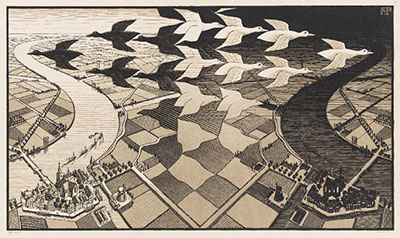
The Evolution of Escher’s Work: Two Distinct Periods
Escher's artistic career can be broadly categorized into two distinct periods. His early work was largely intuitive, driven by his personal fascination with repeating patterns and tessellations without direct collaboration with mathematicians. However, his work entered a new phase of profound depth and sophistication after he began to engage with the mathematical community. In this later period, his art delved into much more complex and abstract concepts. He explored themes of dimension, the topology (or shape) of space, and the nature of infinity. His artistic inquiries were so forward-thinking that some of his work has been seen as anticipating advanced scientific ideas; modern cosmologists have even theorized that the shape of our universe might be "Escher-shaped," suggesting his art touched upon deep features of modern cosmology.
Exploring Infinity, Paradox, and Perception
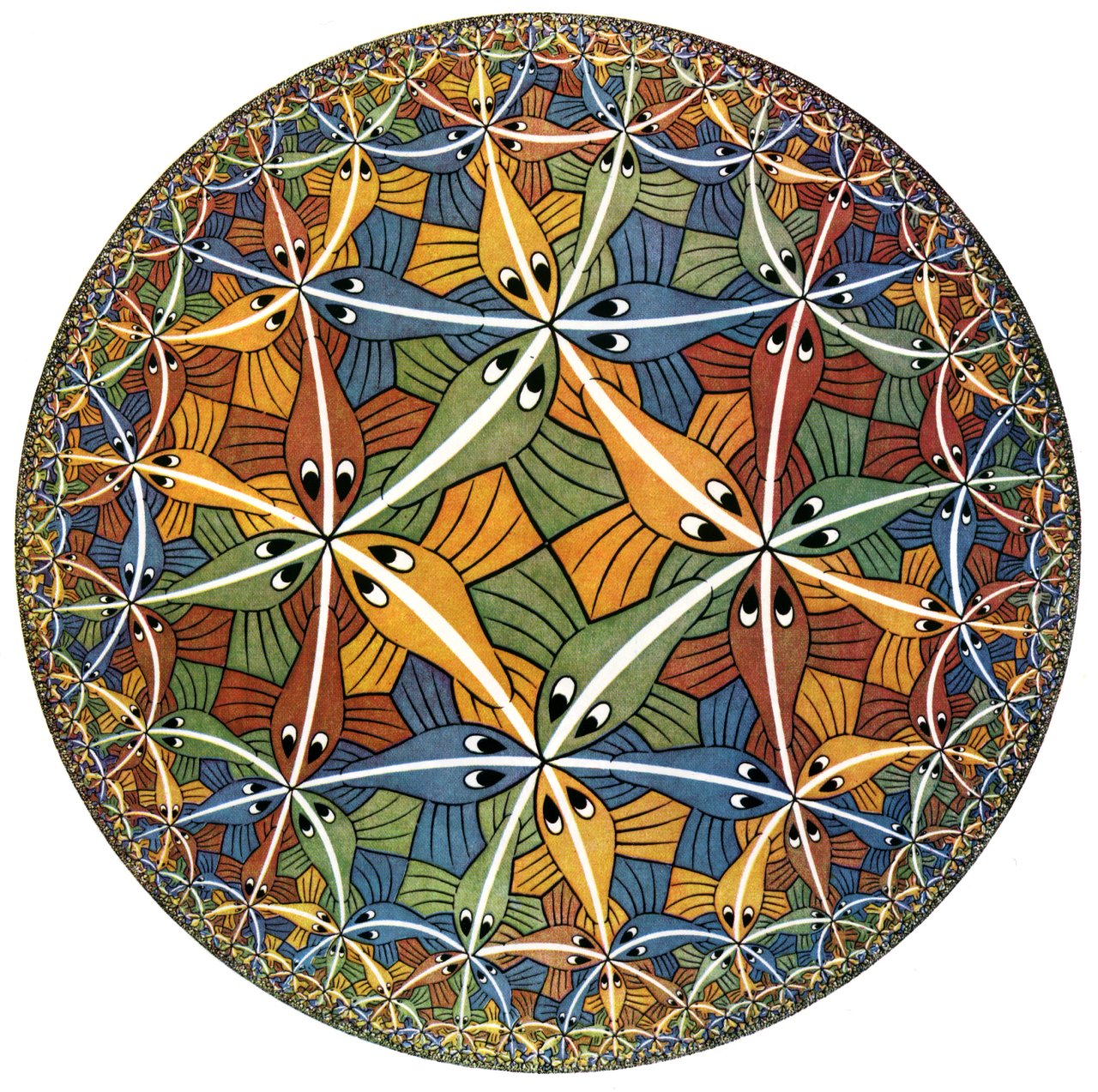
In his later period, Escher created some of his most famous and mathematically rigorous pieces. Using only basic drawing tools, he produced Circle Limit III, an astonishingly accurate representation of space as it edges towards infinity. The work’s precision was so remarkable that, nearly 40 years after its creation, mathematicians confirmed it was mathematically correct down to the millimeter.
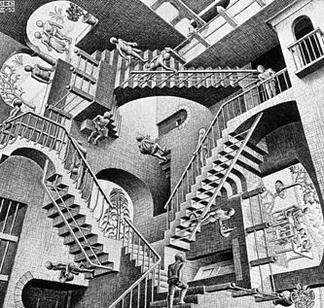
Escher was also deeply inspired by paradoxes and visual illusions. He was fascinated by the work of mathematicians like Roger Penrose, who created the "impossible triangle" and by the peculiar properties of the Möbius strip, an object that appears to have only one side. He used these ideas to create iconic images that look convincing at first glance but defy logic upon closer inspection. These visual illusions serve as a powerful commentary on the nature of perception, demonstrating that our brains do not passively see the world but actively interpret sensory input and make assumptions. Escher's work gives this interpretive part of the brain a "real workout," challenging our understanding of what is real and what is possible.
An Enduring Legacy in Mathematics and Art
Until his death in 1972, Escher remained intrigued by the concepts of infinity, reflection, and perception. His legacy endures, particularly within the world of mathematics. His prints are ubiquitous in university mathematics departments, adorning walls and appearing in textbooks. This is because his art speaks directly to mathematicians, offering a tangible, visual representation of the abstract beauty they find in their field. From a modern perspective, mathematicians understand more clearly what Escher was trying to achieve and can now even write down the formulas that describe the mathematical ideas behind his intuitive creations. Ultimately, M.C. Escher’s greatest contribution was his ability to bridge the gap between two cultures, using his artistic skill to show the wider world that the subject of mathematics is, in its essence, beautiful.

Artificial intelligence is fundamentally altering the landscape of mathematical discovery, moving beyond mere automation to become an indispensable collaborator that will elevate mathematical creativity and rigor. AI's role extends beyond solving existing problems to helping formulate new, insightful questions, thereby accelerating the pace and expanding the scope of mathematical inquiry.
Redefinition of "Mathematical Prowess": As AI takes over routine calculations and proofs, the value of human mathematicians will shift from computational skill to creative problem formulation, deep conceptual understanding, and the ability to ask insightful questions. This will likely raise the bar for what is considered groundbreaking mathematics.
Enhanced Rigor and Trust: The integration of AI-powered verification tools could lead to a new standard of rigor in mathematical proofs, reducing errors and increasing confidence in complex results. This may also transform the peer-review process, making it more efficient and reliable.
Democratization of Mathematical Research: AI tools could lower the barrier to entry for complex mathematical fields, enabling a broader range of researchers to contribute. By automating literature reviews and suggesting promising research directions, AI could empower smaller institutions and individual researchers to tackle problems previously accessible only to elite groups.
New Frontiers of Mathematical Exploration: By identifying patterns and structures beyond human intuition, AI has the potential to unlock entirely new areas of mathematical inquiry, leading to discoveries that were previously unimaginable. This could foster a new golden age of mathematics, characterized by unprecedented collaboration between human and artificial intelligence.
Researchers have captured and controlled quantum uncertainty in real time for the first time, fundamentally redefining the Heisenberg uncertainty principle as a dynamic, tunable property rather than a fixed limitation. This breakthrough, achieved with attosecond (10⁻¹⁸ seconds) precision, enables unprecedented observation and manipulation of quantum states as they evolve naturally, marking a major advance in ultrafast quantum optics.
Central to the achievement is the generation of ultrafast squeezed light pulses—quantum states where uncertainty is redistributed rather than eliminated. Unlike ordinary light, whose uncertainty is spread evenly between paired properties like phase and amplitude, squeezed light narrows uncertainty in one property at the cost of increasing it in the other. Researchers produced the shortest, most precisely controlled attosecond squeezed pulses to date by using nonlinear four-wave mixing in silicon dioxide combined with a custom light field synthesizer that combines multiple carefully phased spectral channels.
This experimental method allowed the team to dynamically switch between amplitude squeezing and phase squeezing in real time, showing that quantum uncertainty can be actively modulated rather than being a static bound. By splitting engineered waveforms into a classical reference and a squeezed beam and precisely measuring their intensity and phase fluctuations, the researchers quantified and controlled quantum noise below the standard quantum limit with attosecond temporal resolution.
The technological implications extend strongly into quantum communications, where the team demonstrated a petahertz-scale encryption protocol embedding information directly in the fluctuating quantum uncertainty patterns. This introduces a robust intrinsic security layer: eavesdropping disturbs the quantum state and also requires knowledge of a decoding key and exact pulse amplitude, making unauthorized interception detectable and decoding practically impossible. This promises ultrafast, highly secure data transfer networks leveraging quantum properties.
Further applications include enhanced quantum sensing, where tailored uncertainty control can improve measurement sensitivity beyond classical limits, enabling breakthroughs in navigation, environmental sensing, and medical diagnostics. The ability to manipulate quantum noise dynamically also points toward future quantum computing architectures operating at extreme speeds and precision, potentially at attosecond timescales.
This discovery, achieved through the intersection of nonlinear optics, laser physics, and quantum theory, transforms quantum uncertainty from a passive obstacle to an actively exploitable resource. It opens new frontiers in fundamental quantum physics and sets the stage for revolutionary quantum technologies far beyond existing capabilities. By bridging attosecond temporal control with quantum state engineering, the work marks a pivotal step toward harnessing the full potential of quantum mechanics in real-world applications and advanced scientific research.
This new approach to physics-informed neural networks (PINNs) enables robust solutions for stiff and high-dimensional differential equations by combining multi-head architectures and unimodular regularization. The multi-head strategy allows a single neural net to solve an entire family of equations simultaneously, improving generalization and handling noisy or sparse data. Unimodular regularization, leveraging ideas from differential geometry, stabilizes training and allows the system to efficiently uncover unknown or missing physical laws.
Applications are wide-ranging:
Astrophysics and Relativity: Direct solution of Einstein Field Equations and the modeling of complex spacetime geometries.
Climate Science: Modeling atmospheric dynamics and coupled climate models that involve many scales and stiff systems.
Chemical Kinetics and Biology: Simulation and inference in biochemical networks, metabolic pathways, and reaction-diffusion systems with rapid and slow processes intertwined.
Engineering: Fluid dynamics (including turbulent and reactive flows), aerodynamics, material deformation, and control systems where traditional solvers fail due to stiffness or sensitivity.
Environmental Science: Predictive modeling for air pollution, PM2.5 evolution, and other multi-timescale diffusion-advection problems.
The net result: faster, more accurate, and more versatile model training and simulation for any field that relies on solving or inferring complex differential equations under challenging data or physical constraints.
Refs:
[1] EPINN: Physics-Informed Neural Network with exponential activation functions for solving stiff ODEs
[2] Solving stiff ordinary differential equations using physics informed neural networks (PINNs): simple recipes to improve training of vanilla-PINNs
[3] Stiff neural ordinary differential equations
[4] Stabilize physics-informed neural networks for stiff differential equations: Re-spacing layer
[5] Mixing Differential Equations and Neural Networks for Physics-Informed Learning
[6] Training stiff neural ordinary differential equations with implicit single-step methods
The Ig Nobel Prizes honor achievements so surprising that they make people LAUGH, then THINK. The prizes are intended to celebrate the unusual, honor the imaginative — and spur people’s interest in science, medicine, and technology.
Ice can generate electricity in two ways: flexoelectricity, triggered when ice is bent or deformed, and ferroelectricity, present at the surface in extremely cold conditions. This explains how ice particles in thunderclouds become charged, revealing a likely mechanism behind lightning initiation. Ice’s electrical output, comparable to high-performance ceramics, enables potential uses in sensors and transducers, especially in harsh, cold environments where traditional electronics fail. These findings open up new technological possibilities and deepen our understanding of natural electrical phenomena in polar and stormy regions.
Unlike traditional spatial crystals such as diamonds, where atoms form repeating patterns in three-dimensional space, time crystals exhibit periodic motion in the temporal dimension.
By stacking multiple time crystal layers, engineers could potentially create unprecedented data storage systems that encode information in both spatial and temporal domains.
The Kepler Problem
First theorized to exist back in the 1940s, the leftover glow from the Big Bang — also known as the cosmic microwave background, or CMB — was confirmed to exist back in the mid-1960s. Although many have questioned its interpretation and ultimate origin, its detailed properties not only confirm its emergence from a hot Big Bang, but provide many other cosmic insights. Yet still, even today, one huge cosmic mystery looms large: the Hubble tension. Here’s what we know about the CMB, plus what still remains to be discovered about our Universe.
In 2024, artificial intelligence (AI), for the first time, helped win a Nobel Prize. DeepMind’s AlphaFold cracked one of biology’s hardest puzzles: protein folding, the challenge of predicting how a chain of amino acids twists into the intricate 3D shape that determines its function. Scientists had struggled with this problem for decades. It was crucial for medicine and drug discovery but seemed unsolvable due to the astronomical number of possible protein structures. Then AI delivered the answer.
A game-changer, no doubt. But it also raises the question: what does this mean for science and for scientists? Is traditional scientific inquiry becoming obsolete? Are we approaching a future where algorithms are the primary drivers of discovery, relegating humans to the sidelines?
Throughout history, every breakthrough technology has redefined how discoveries were made, marking four distinct eras of science [1] (Fig 1). The first, the empirical era, relied on direct observation, as Copernicus challenged the Earth-centered view of the universe by observing the skies. The second, the theoretical era, introduced mathematics to predict nature, like Newton’s equations of motion that shaped physics for centuries. The third, the computational era, which began in the 1950s, harnessed computers to simulate complex systems, leading to Kohn and Pople’s quantum chemistry Nobel Prize. The fourth, the data-driven era of our 21st century, uses machine learning to extract patterns from vast datasets, with AlphaFold solving protein structures by learning from the protein data bank [2].
Today, we stand at the doorstep of the fifth era of science—the artificial scientific intelligence era—where companies like Google, Lila Sciences, and Sakana are unveiling AI scientists that not only assist research but drive discoveries, generate hypotheses, and test them on their own [3–5] (Fig 1). Hence, why not let AI run the show from here?
In some fields, perhaps we can. In chemistry, organic synthesis—the process of assembling complex drug-like molecules from basic building blocks—is now guided by interpretable AI models that help scientists plan each step [6]. In materials science, generative AI can design novel inorganic compounds with tailored mechanical, electronic, and magnetic properties, accelerating innovation with minimal human tuning [7]. These are domains where experimental feedback is relatively tractable, simulations are mature and the data is plentiful and structured. In short, these fields provide ideal conditions for autonomous AI exploration.
But in many other areas, letting an AI run the show today would be like sending a self-driving car down a dirt road with half a map and no GPS. AI might have the horsepower, but it still needs humans to steer it around the pitfalls of specialized scientific data. Nowhere is this clearer than in biomedical imaging, where highly curated datasets are nothing like what traditional large vision models are trained on.
First, biomedical imaging datasets are often tiny by AI standards, and for good reason: collecting them requires technical equipment and trained professionals; labeling them demands significant time and expert input; and strict privacy regulations often limit access. MedPix, a leading medical imaging database, contains just 59,000 images and the Allen Cell Feature Explorer, one of the largest publicly available collections of high-resolution 3D images of human stem cells, only around 32,000 images. That is about a thousand times fewer than what is needed for AI to perform. This is where scientists step in.
Scientists are redefining AI to do more with less, helping algorithms find meaning in images even when data are scarce. One approach involves using mathematical insights to redesign the core building blocks of neural networks. Traditional models fall apart when we strip away their layers or parameters, but these new architectures stay strong—even with just a single layer and two convolutional filters [8]—precisely because they are built to thrive on small data. And, scientists do not just bend the design of the model to fit the lack of data, they also reimagine the data ecosystem to power the model; they decide what data to collect, how to collect it, and how to weave together existing, but fragmented, specialized datasets to train AI models for a wide variety of tasks, including brain tumor classification or diabetic retinopathy grading [9].
But scientific data is not just scarce, it is often noisy. Cryo-electron microscopy (cryo-EM), a Nobel Prize-winning technology that lets us see the invisible [10]—revealing molecules at the tiniest scale—produces incredibly blurry images, where the important details are 100 times weaker than the noise. It is like trying to recognize a friend in a crowd while wearing someone else’s prescription glasses. This stands in stark contrast to the crisp, high-resolution images—like street scenes, faces, or everyday objects—that traditional AI vision models are trained on.
Yet scientists have techniques to extract meaning from even the noisiest images. In cryo-EM, they can reconstruct the 3D shapes of molecules buried in noise; for example, providing the first high-resolution images of SARS-CoV-2 during the COVID-19 pandemic [11,12]. Today, they are combining that hard-won expertise with the power of AI. One breakthrough pairs a powerful denoising module with a foundation model, enabling AI to tackle the notoriously difficult processing steps of cryo-EM images [13]. Crucially, this was only possible because scientists also applied their domain expertise to curate a high-quality dataset by cleaning, annotating, and aggregating 529 verified cryo-EM datasets into one large training set that AI could learn from.
It is clear that AI presents an enormous opportunity for science, potentially the most powerful tool we have ever had in our arsenal. But the fifth era of artificial scientific intelligence is not void of human scientists: quite the opposite. In many ways, the future of revolutionary discoveries lies in this synergy: human expertise guiding AI, and AI augmenting human expertise. It is as if we have hired the most overachieving and wildly enthusiastic intern; one who works at superhuman speed, never sleeps, and eagerly devours mountains of data. They hold exceptional potential, but without proper guidance anchored in scientific knowledge, they are more likely to set the lab on fire than to push science forward.
Instead of hoping AI will magically handle limited, noisy, specialized data, we need experts to tailor algorithms to the realities of fields like biology and medicine, and to tailor data to the new requirements of the AI technology. To enter the fifth era of science, we need to equip researchers with AI expertise, AI experts with domain knowledge, and universities with interdisciplinary programs. The labs that thrive will be those where domain experts and AI specialists work in sync or where scientists master both. The next scientific revolution will come from teams who can judiciously steer AI, knowing when to trust it, when to adjust its course, and when to drive it into uncharted territory.
The paper introduces a theoretical framework based on three-dimensional time, where the three temporal dimensions emerge from fundamental symmetry requirements. The necessity for exactly three temporal dimensions arises from observed quantum-classical-cosmological transitions that manifest at three distinct scales: quantum phenomena, interaction-scale processes, and cosmological evolution. These temporal scales directly generate three particle generations through eigenvalue equations of the temporal metric, naturally explaining both the number of generations and their mass hierarchy.
The framework proposes a metric structure with three temporal and three spatial dimensions, preserving causality and unitarity while extending standard quantum mechanics and field theory. While earlier work explored three-dimensional time in the context of Kaluza–Klein theory, this paper’s approach provides specific experimental predictions and a complete particle spectrum.
This approach offers elegant solutions to long-standing problems in particle physics: the three-generation structure emerges naturally from temporal symmetries, weak interaction parity violation arises from geometric properties, and quantum gravity achieves finite corrections without ultraviolet divergences.
The theory reproduces known particle properties and makes precise quantitative predictions, including neutrino masses, new resonances, and modifications to gravitational wave propagation. These signatures are expected to be testable through next-generation collider experiments, gravitational wave observatories, and cosmological surveys in the 2025–2030 timeframe. Notably, General Relativity emerges as a natural limiting case when two temporal dimensions become negligible.
The New York Times article “Pi Day: How One Irrational Number Made Us Modern” details the fascinating history of pi (π), the mathematical constant representing the ratio of a circle’s circumference to its diameter, and its surprisingly pervasive influence on modern technology and scientific advancement. The article traces pi’s journey from ancient approximations to its current calculation of trillions of digits, highlighting how each stage of refinement has unlocked new possibilities.
The story begins in ancient civilizations – Babylonians and Egyptians – who recognized the consistent relationship between a circle’s circumference and diameter, but lacked the tools for precise calculation. They arrived at approximations, with the Babylonians using 3 and the Egyptians employing a value around 3.16. These early estimations were sufficient for practical purposes like land surveying and construction, but lacked the precision needed for more complex mathematical endeavors. The article emphasizes that these weren’t failures, but rather pragmatic solutions for the needs of the time.
A significant leap occurred with Archimedes in the 3rd century BC. He devised a method of approximating pi by inscribing and circumscribing polygons within and around a circle. By increasing the number of sides of these polygons, he progressively narrowed the range within which pi must lie, ultimately arriving at an approximation between 3 1/7 and 3 10/71. This method, while laborious, represented the first rigorous mathematical approach to determining pi’s value and established a foundation for future calculations.
For centuries following Archimedes, progress was slow. Chinese mathematicians, notably Zu Chongzhi in the 5th century AD, achieved remarkable accuracy, calculating pi to seven decimal places – a record that stood for nearly a millennium. However, the article points out that this knowledge remained largely confined to specific regions and didn’t immediately translate into widespread mathematical or technological breakthroughs. The limitations were not in the understanding of pi itself, but in the broader mathematical framework needed to utilize such precision.
The Renaissance and the advent of calculus in the 17th century marked a turning point. Mathematicians like Isaac Newton and Gottfried Wilhelm Leibniz discovered infinite series representations for pi, providing formulas that could, in theory, calculate pi to any desired degree of accuracy. These series, however, converged slowly, meaning a vast number of terms were needed for even modest improvements in precision. The article explains that this period wasn’t just about finding more digits, but about developing new mathematical tools – calculus – that fundamentally changed how mathematicians approached problems.
The 18th and 19th centuries saw a flurry of activity focused on refining these series and discovering new ones. Mathematicians like Johann Heinrich Lambert proved that pi is irrational – meaning it cannot be expressed as a simple fraction – a crucial theoretical breakthrough. Later, Ferdinand von Lindemann proved that pi is transcendental, meaning it is not the root of any polynomial equation with integer coefficients. This proof definitively settled long-standing questions about the nature of pi and had implications for geometric constructions, notably proving the impossibility of “squaring the circle” using only a compass and straightedge.
The 20th and 21st centuries witnessed an explosion in pi’s calculation, driven not by a need for greater accuracy in practical applications, but by the development of increasingly powerful computers. The article details how calculating pi became a benchmark for testing computer hardware and algorithms. Each new record for the number of digits calculated demonstrated advancements in computing power and efficiency. The pursuit of pi digits became a form of computational sport, pushing the boundaries of what was possible.
However, the article stresses that pi’s importance extends far beyond its role as a computational test. It is fundamental to numerous fields of science and engineering. Pi appears in formulas describing everything from the behavior of pendulums and the propagation of waves to the principles of quantum mechanics and the curvature of spacetime in Einstein’s theory of relativity. It’s essential for signal processing, image compression, and the design of everything from bridges and buildings to smartphones and satellites.
The article highlights specific examples: the Global Positioning System (GPS) relies on incredibly precise calculations involving pi to determine location; the design of circular structures, like lenses and antennas, depends on accurate pi values; and even the seemingly unrelated field of statistics utilizes pi in probability distributions like the normal distribution.
Finally, the article touches upon the cultural significance of Pi Day (March 14th – 3/14), a celebration of this remarkable number that has grown in popularity, reflecting a broader public appreciation for mathematics and its role in shaping our world. It’s a reminder that even an abstract mathematical concept like pi has a tangible and profound impact on our daily lives, underpinning much of the modern technology we take for granted. The ongoing fascination with pi, the article concludes, is a testament to its enduring beauty and its central role in our understanding of the universe.